Top 10 Free Wheel Railway Set Suppliers Worldwide
A dependable Free-Wheel Railway Set begins with more than an attractive product photo. Buyers need to know how the wheels move, what the tracks are made from, and whether the pieces fit together securely. Small details matter: a loose axle, rough track edge, or flimsy connector can turn a promising sample into a disappointing order. This guide introduces ten suppliers worldwide and offers practical points for comparing their products, customization options, production capacity, and communication.
Supplier claims deserve careful checking. Request a sample and test it on the intended surface. Ask for dimensions, material details, packaging specifications, and relevant product-safety documentation for your market. One illustrative industry voice, fictional sourcing specialist Adrian Cole, puts it this way: “A smooth wheel proves little until the set runs reliably on its actual track.” This is an original illustrative quotation, not a verified statement from an identifiable expert. That distinction matters. A supplier list can help narrow the search, but it cannot replace independent checks, clear written specifications, and direct conversations with manufacturers. Even a neat catalog can leave important questions unanswered. Look closely. Compare the details, not just the price.
Understanding Free-Wheel Railway Sets and Their Main Components
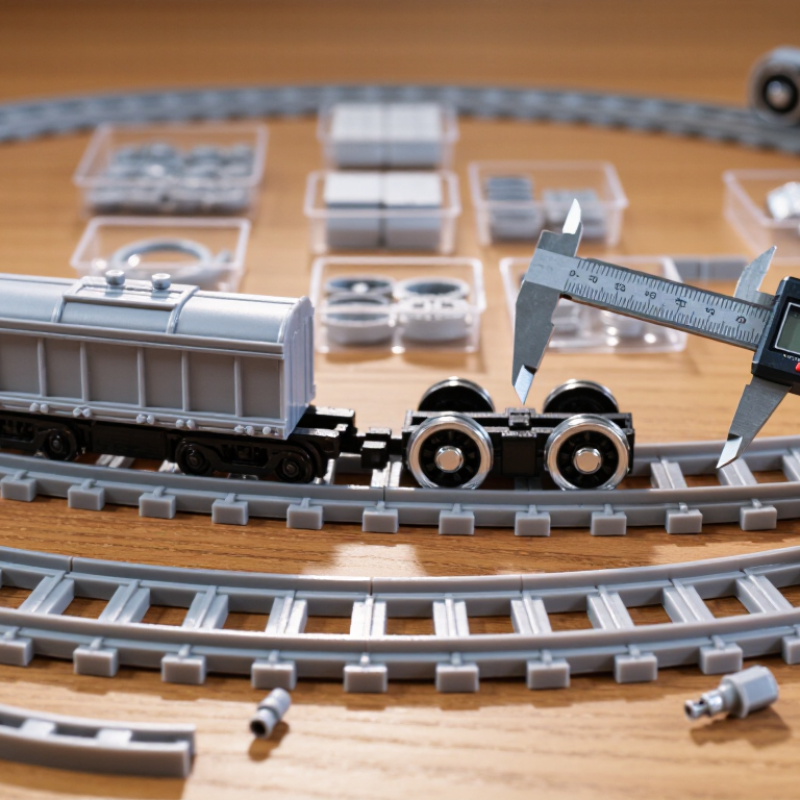
A free-wheel railway set is a small train system that rolls without a motor driving its wheels. A child can push the locomotive or a carriage, then watch it coast along the track. Simple? Yes, but smooth movement depends on several parts working together. The term can also vary between suppliers, so check whether the set includes a locomotive, loose cars, or both.
The track guides the wheels and sets the route. Straight sections create a run-up; curved pieces turn the train, while connectors keep adjoining rails aligned. Under each carriage, axles hold the wheels in position, and the chassis supports the body. Couplers join cars and should bend freely without separating during ordinary play. Small details matter. A wheel that rubs against its frame can slow the whole train.
When comparing suppliers, inspect the listed materials, dimensions, and included track pieces rather than relying on photographs alone. Check that wheels rotate evenly and that rail joints sit flush on a flat surface. I have found product descriptions can leave out useful details, such as whether extra cars are compatible. That uncertainty is worth noting, not guessing away. A clear parts list makes it easier to judge what arrives in the box and whether the set can be expanded later.
Top 10 Free Wheel Railway Set Suppliers Worldwide - Understanding Free-Wheel Railway Sets and Their Main Components
This is an illustrative sourcing guide, not a verified supplier directory or ranking. Regions indicate possible manufacturing and sourcing markets; capabilities should be confirmed directly with each supplier. A free-wheel railway set is a non-powered toy set whose wheels turn freely when pushed.
| No. | Potential Sourcing Region | Supplier Category | Typical Product Focus | Main Components to Discuss | Checks Before Ordering |
|---|---|---|---|---|---|
| 1 | China | Toy-set manufacturers and contract assemblers | Multi-piece plastic railway sets and accessory packs | Molded track, rolling stock bodies, wheels, axles, couplers, and packaging | Request material specifications, sample assemblies, age grading, and destination-market test documentation |
| 2 | Japan | Precision toy and small-component manufacturers | Compact rolling stock, detailed parts, and fitted wheel assemblies | Wheel profiles, axle fit, couplers, and molded or assembled vehicle shells | Check wheel rotation, track compatibility, dimensional tolerances, and spare-part availability |
| 3 | Germany | Toy engineering and plastics suppliers | Durable track pieces, locomotives, and compatible accessories | Track connectors, curve sections, wheel sets, and car-body components | Confirm the intended age group, product safety records, and fit across all set components |
| 4 | Czechia | Plastic-molding and toy-component suppliers | Molded railway accessories and small-batch vehicle parts | Track sections, supports, couplers, wheels, and accessory molds | Review mold ownership, production capacity, sample quality, and color consistency |
| 5 | Poland | Toy assembly and packaging suppliers | Set assembly, component kitting, and retail-ready packs | Sorted track, rolling stock, instruction sheets, and packaging inserts | Specify piece counts, packaging tests, labeling language, and inspection sampling |
| 6 | Italy | Design-led toy and molded-plastic suppliers | Decorative vehicles, scenery, and coordinated play accessories | Vehicle shells, scenery pieces, track connectors, and non-powered wheel assemblies | Check finish quality, small-part risks, colorfastness, and compatibility with the track layout |
| 7 | United Kingdom | Toy suppliers and product-development partners | Retail-oriented sets, packaging development, and product sourcing | Complete set contents, instructions, track pieces, and rolling stock | Verify importer responsibilities, applicable safety requirements, and traceability documents |
| 8 | United States | Toy brands' contract-manufacturing and distribution partners | Product specification, final assembly, and domestic distribution | Track layouts, free-rolling vehicles, couplers, instructions, and retail packaging | Confirm manufacturing origin, testing scope, labeling, and availability of replacement pieces |
| 9 | Mexico | Plastics manufacturers and assembly suppliers | Molded components, kitting, and regional production support | Plastic track, vehicle bodies, wheel parts, and packed accessories | Assess tooling capability, material declarations, production controls, and shipping arrangements |
| 10 | India | Toy-component, packaging, and assembly suppliers | Plastic parts, set assembly, and packaging production | Track sections, vehicle shells, wheels, axles, and printed instructions | Request production samples, capacity details, safety-test evidence, and agreed quality criteria |
Main Components of a Free-Wheel Railway Set
| Component | Purpose | Common Materials or Features |
|---|---|---|
| Track sections | Create straight, curved, or branching paths for the vehicles. | Often molded plastic; connection design and track gauge must match the vehicles. |
| Locomotive and carriages | Provide the train bodies and play themes; in a free-wheel set, they are moved by hand rather than powered by a motor. | Molded plastic, wood, or combinations of materials, depending on the product design. |
| Wheels and axles | Support the vehicle and allow it to roll along a surface or track. | Wheel material and axle construction vary; wheels should turn freely and remain securely attached. |
| Couplers | Connect locomotives and carriages where the design allows them to be linked. | May be fixed, hook-style, or another compatible mechanical design. |
| Accessories and instructions | Add scenery or play elements and explain assembly and safe use. | May include signs, supports, scenery pieces, and printed instructions; contents vary by set. |
How to Evaluate Railway Set Suppliers Worldwide
When comparing worldwide suppliers of free-wheel railway sets, look beyond price and polished product photographs. Check whether each listing specifies wheel material, axle spacing, track gauge, coupler type, and compatible power options. Small details matter. Request a sample and test it on both straight and curved track. Listen for scraping, watch for wobbling wheels, and check whether couplers stay connected during repeated runs. Inspect molded edges and packaging for parts that could bend in transit. A reliable supplier should provide dated inspection records, clear packing lists, and realistic production and shipping estimates. Ask how defects are recorded and replacement parts are handled. Vague answers are a warning.
Compare quotations using the same set configuration, packaging, and delivery terms. Ask for recent production photos or a video showing the actual wheels moving; a catalog image proves little. Check whether technical documents use consistent measurements and whether questions receive specific replies. Fast responses help, but accuracy matters more. No checklist catches every issue. A sample may perform well while a larger batch varies, so ask how quality is checked across production. It is easy to focus on low cost and overlook small fit problems; those can make assembly frustrating. Record your test results, even if they seem minor.
Leading Free-Wheel Railway Set Suppliers by Region
Regional sourcing for free-wheel railway sets depends on tooling, materials, and shipment scale. In Asia-Pacific, established toy-manufacturing clusters can support molded track, compact rolling stock, and high-volume assembly. Buyers should inspect wheel alignment and track joints on physical samples; small defects can stop a train during play. Scale helps, but it is not proof of quality.
European suppliers may suit buyers prioritizing detailed product documentation and consistent finishing. North American suppliers can offer shorter replenishment routes for regional retailers. These are broad patterns, not guarantees. Circana’s 2023 toy-market review reported a 7% sales decline across 12 tracked markets, a reminder that demand can shift by region and year. That report covers toys broadly, not railway sets alone.
A supplier comparison should therefore include lead time, minimum order quantity, material declarations, and defect-control records—not just unit price. One weak point in many comparisons: sample quality may not reflect a full production run.
Comparing Product Range, Quality, and Customization
A useful comparison of the top 10 free wheel railway set suppliers starts with product range, not catalogue size alone. Check whether each supplier offers matched wheelsets, axle options, bearing interfaces, and documented traceability.
Quality is best judged through evidence: material certificates, dimensional inspection records, non-destructive testing procedures, and clear acceptance criteria. Ask how suppliers control wheel profile, axle fit, and balance across production batches. A polished brochure is not enough. Review a sample inspection report, and confirm that it matches the exact configuration being quoted. EN 13260 provides requirements for wheelsets, while the buyer should still verify applicable specifications for the intended vehicle and operating conditions.
Customization can separate a capable supplier from a merely broad one. Compare its ability to adapt wheel diameter, axle length, bearing seats, and documentation to your project. Request lead times for both standard and modified assemblies, plus the process for handling design changes. A practical scorecard helps, though it has limits: delivery performance and after-sales support can vary by region and order size. That part is easy to underestimate.
Factors to Consider When Choosing a Supplier
When comparing free wheel railway set suppliers, look beyond price and catalog dimensions. Ask for material certificates, heat-treatment records, dimensional tolerances, and fatigue-test results for the exact configuration you plan to buy. A wheelset must match axle load, operating speed, track conditions, and maintenance practice. A neat catalog is not proof. Request sample inspection reports and confirm how each component can be traced to its production batch.
Quality systems matter, but check their scope. ISO 22163 certification can indicate a railway-focused quality management system; it does not replace product-specific testing. The IEA’s 2019 Future of Rail report estimates that rail carries 8% of global passenger transport and 7% of freight transport, while using 2% of transport energy. That scale makes reliability and efficient maintenance practical concerns, not just selling points. Ask suppliers for documented service intervals, spare-part lead times, warranty limits, and procedures for handling defects.
Compare delivery capacity alongside engineering support. Request a realistic production schedule, packaging details, and evidence that parts will arrive protected from moisture and impact. Check whether drawings, inspection records, and installation guidance are supplied in a usable format. One detail is easy to miss: a technically suitable set may still create delays if its interfaces differ from existing equipment. Paperwork can look complete and still leave a gap, so have your engineering team review the drawings before placing an order.
