China Top 10 COB LED Strip Light Manufacturers
COB LED strip light technology has changed how manufacturers deliver continuous, dot-free illumination in narrow spaces. A well-made strip can trace a kitchen shelf, illuminate a display edge, or sit inside a shallow aluminum channel. But smooth light alone does not guarantee a dependable product. Buyers must also check color consistency, heat management, dimming compatibility, adhesive quality, and documented testing.
The market is expanding. Grand View Research estimated the global LED lighting market at USD 75.8 billion in 2024, with projected growth through 2030. This figure covers LED lighting broadly, not COB strips alone. That distinction matters. No single market estimate can verify a manufacturer’s product quality. For practical context, lighting researcher Dr. Mariana Figueiro has described light as “medicine,” underscoring that lighting affects people, not just surfaces. Her work concerns light and health, rather than COB strip manufacturing specifically.
This guide compares ten manufacturers through product range, technical documentation, customization, and manufacturing experience. Look for clear specifications: watts per meter, color-rendering data, voltage drop guidance, and maximum run length. Ask how the strip handles heat in a confined profile. Small details matter. A bright sample on a workbench may perform differently beneath a warm cabinet, after hours of use. Rankings also have limits; factory claims and online catalogs do not replace independent testing. Use the list as a starting point, then verify samples against your own installation requirements.
What COB LED Strip Lights Are and How They Work
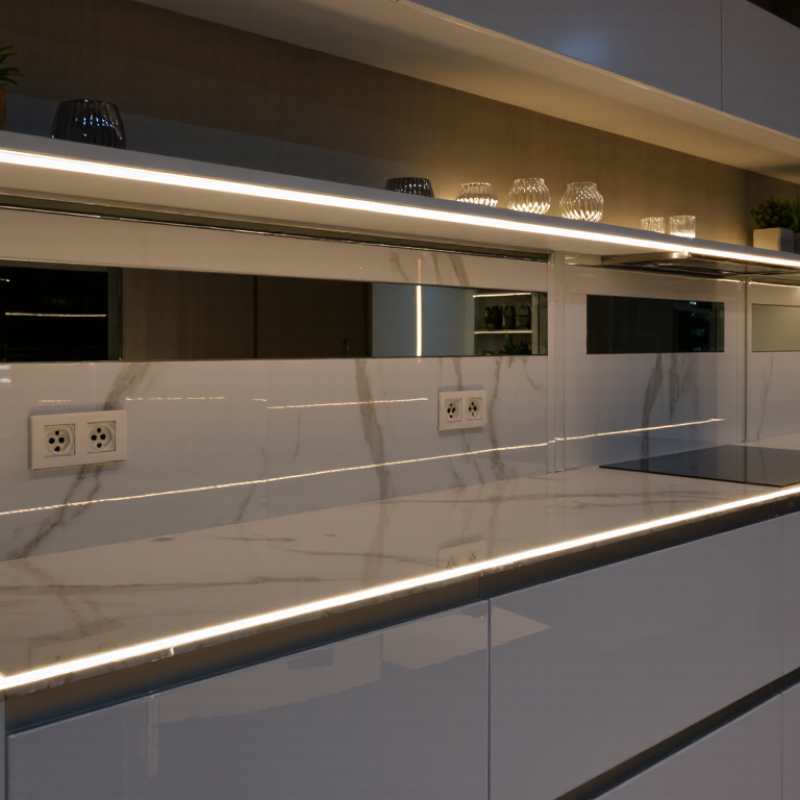
COB LED strip lights place many small LED chips closely together on a flexible circuit board. A continuous phosphor coating spreads their light into a smooth line, rather than separate bright dots. This makes them useful under kitchen cabinets, along shelves, or inside shallow display channels. The strip still needs a suitable power supply, and its voltage must match the product specifications.
Electric current travels through copper tracks on the circuit board and powers the chips. The coating blends their output, but it does not remove heat. Longer runs can also show uneven brightness if voltage drops along the strip. In practice, check the maker’s guidance for run length, power, and heat management. COB describes the light source, not a guarantee of identical quality or performance. That distinction is easy to miss.
Tips: Measure the installation and cut only at marked points. Test the strip before fixing it in place. Keep it on a clean, dry surface. A diffuser may still help protect the strip, though the light already looks continuous.
How to Assess Chinese COB LED Strip Light Manufacturers
Assess Chinese COB LED strip manufacturers through test records, not polished catalog photos. The IEA’s 2023 lighting analysis estimates lighting uses about 15% of global electricity. That makes measured efficiency relevant, but it does not prove one supplier’s strip performs well. Ask for independent test reports showing lumens per watt, power consumption, color rendering, and color-temperature consistency. Compare results at the same voltage, strip length, and operating temperature.
The U.S. Department of Energy’s Solid-State Lighting R&D Opportunities report identifies efficacy, color quality, and reliability as key performance areas. Request LM-80 data for the LED package and a clearly explained TM-21 lifetime projection; neither alone guarantees the finished strip’s lifespan. Inspect samples after several hours of operation. Look for uneven brightness, color shifts, hot spots, and adhesive lifting near corners. Small details matter. Also check copper thickness, LED spacing, cut-point accuracy, and voltage drop across a five-metre reel. Ask how each production batch is inspected and whether failed samples are retained. A neat datasheet is not proof. I would still treat supplier claims cautiously when test conditions are missing; that gap is easy to overlook.
How to Assess COB LED Strip Light Manufacturers
Suggested evaluation weights for comparing manufacturers. These are a practical assessment framework, not measured market statistics.
Prioritize technical documentation and product consistency, then verify compliance records, customization capabilities, delivery reliability, and after-sales support using evidence from each supplier.
China’s Top 10 COB LED Strip Light Manufacturers
China’s top ten COB LED strip light manufacturers should be compared by measurable performance, not catalogue photos. COB strips create a continuous line of light, but dense LEDs can still run hot inside an aluminum channel. Check delivered lumens per meter, power consumption, color temperature tolerance, color rendering, and performance after thermal testing. Ask for test reports and a sample reel; inspect whether the color stays even around corners and after dimming. Small details matter.
The U.S. Department of Energy’s LED lighting guidance reports that LEDs use at least 75% less energy and can last up to 25 times longer than incandescent lighting. This is a broad LED comparison, not a lifespan guarantee for any COB strip. For supplier evaluation, request operating-temperature and lifetime evidence, plus details on the test conditions. Also compare copper thickness, adhesive strength, cut-point spacing, and stated voltage drop across a full reel. A polished datasheet is useful, but it can omit real installation problems. I would treat unsupported lifetime claims cautiously. China’s leading suppliers may differ sharply in documentation and quality control, even when their strips look similar.
Products, Capabilities, and Certifications Compared
COB LED strip lights create a continuous line of light, with fewer visible dots than conventional strip designs. When comparing China’s top manufacturers, look beyond product photos. Check available widths, color temperatures, brightness options, and cutting intervals. Ask whether sample reels match the production specification. Small differences matter.
Manufacturing capabilities can include custom lengths, dimming options, waterproof coatings, and tailored packaging. Compare minimum order quantities and stated lead times, but confirm both in writing. Certifications also need careful review. Check that reports apply to the exact product model and intended market. CE or RoHS documents alone may not answer every safety or performance question. Request test reports from recognized laboratories where relevant. Some supplier information is incomplete, so a neat comparison table can still hide gaps.
Tips: Request a sample reel and inspect color consistency, adhesive strength, and heat behavior during a realistic installation. Ask for a datasheet, warranty terms, and traceable test records. Do not assume every variation shares the same certification.
China Top 10 COB LED Strip Light Manufacturers - Products, Capabilities, and Certifications Compared
Data integrity note: No source documents or independently verified supplier records were provided. The anonymous entries below are comparison placeholders, not a verified ranking or claims about specific manufacturers. Supplier-specific product capabilities and certifications should be confirmed using current datasheets, test reports, and certificates.
| Entry | COB Product Range | Voltage & Cut-Interval Options | Color & Dimming Options | Manufacturing Capabilities to Verify | Certification Evidence to Request | Verification Status |
|---|---|---|---|---|---|---|
| Supplier 01 | Not independently verified | Request product-specific datasheets | Request available CCT, CRI, and dimming specifications | Confirm PCB width, LED density, reel length, and customization options | Request current, model-specific reports for applicable safety, EMC, and restricted-substance requirements | Unverified |
| Supplier 02 | Not independently verified | Request product-specific datasheets | Request available CCT, CRI, and dimming specifications | Confirm PCB width, LED density, reel length, and customization options | Request current, model-specific reports for applicable safety, EMC, and restricted-substance requirements | Unverified |
| Supplier 03 | Not independently verified | Request product-specific datasheets | Request available CCT, CRI, and dimming specifications | Confirm PCB width, LED density, reel length, and customization options | Request current, model-specific reports for applicable safety, EMC, and restricted-substance requirements | Unverified |
| Supplier 04 | Not independently verified | Request product-specific datasheets | Request available CCT, CRI, and dimming specifications | Confirm PCB width, LED density, reel length, and customization options | Request current, model-specific reports for applicable safety, EMC, and restricted-substance requirements | Unverified |
| Supplier 05 | Not independently verified | Request product-specific datasheets | Request available CCT, CRI, and dimming specifications | Confirm PCB width, LED density, reel length, and customization options | Request current, model-specific reports for applicable safety, EMC, and restricted-substance requirements | Unverified |
| Supplier 06 | Not independently verified | Request product-specific datasheets | Request available CCT, CRI, and dimming specifications | Confirm PCB width, LED density, reel length, and customization options | Request current, model-specific reports for applicable safety, EMC, and restricted-substance requirements | Unverified |
| Supplier 07 | Not independently verified | Request product-specific datasheets | Request available CCT, CRI, and dimming specifications | Confirm PCB width, LED density, reel length, and customization options | Request current, model-specific reports for applicable safety, EMC, and restricted-substance requirements | Unverified |
| Supplier 08 | Not independently verified | Request product-specific datasheets | Request available CCT, CRI, and dimming specifications | Confirm PCB width, LED density, reel length, and customization options | Request current, model-specific reports for applicable safety, EMC, and restricted-substance requirements | Unverified |
| Supplier 09 | Not independently verified | Request product-specific datasheets | Request available CCT, CRI, and dimming specifications | Confirm PCB width, LED density, reel length, and customization options | Request current, model-specific reports for applicable safety, EMC, and restricted-substance requirements | Unverified |
| Supplier 10 | Not independently verified | Request product-specific datasheets | Request available CCT, CRI, and dimming specifications | Confirm PCB width, LED density, reel length, and customization options | Request current, model-specific reports for applicable safety, EMC, and restricted-substance requirements | Unverified |
Certification applicability depends on the product, destination market, and intended installation. Verify that each certificate or test report identifies the relevant product model and is issued by an appropriate organization; do not treat a company-level certificate as proof that every strip-light model is certified.
How to Choose a COB LED Strip Light Manufacturer in China
Choosing a COB LED strip manufacturer in China starts with measurable process control, not a polished sample. The International Energy Agency’s Energy Efficiency 2023 report estimated that LEDs accounted for about half of global lighting sales in 2022. That scale makes consistent binning and traceable production important. Ask how the factory controls color consistency, brightness, and solder quality across full production runs. Request test records for the exact strip configuration, including voltage, power per meter, and operating temperature. Small details matter. A white strip can look even on a desk, then show color shifts after installation.
Check thermal design and performance data before comparing prices. Ask for copper thickness, recommended installation surface, and temperature-rise test conditions. Request LM-80 data for the LED components where available, but do not mistake component data for proof of complete-strip lifetime. A useful supplier should explain its test setup clearly. Ask for samples from different production batches, then compare color and brightness side by side. Inspect the adhesive after applying a short section to a clean aluminum profile. I would not treat one attractive sample as proof; it is only a starting point. Confirm that quoted specifications match the product datasheet and the sample you receive.
