What Is an LED Tri-Proof Light and How Does It Work?
An LED Tri-Proof Light is a sealed fixture designed for demanding indoor and outdoor environments. It commonly resists dust, moisture, corrosion, and accidental impact. The word “tri-proof” sounds precise, but manufacturers may define it differently. Always check the product’s tested ratings.
These lights often use a linear LED board, an aluminum heat sink, and a protective diffuser. Electricity flows through a driver, which regulates power before reaching the LEDs. The diodes then convert electrical energy into visible light with limited heat production. The housing helps protect internal parts from water, dust, and physical contact. In a warehouse, this may mean steady illumination above aisles, loading areas, or cold storage doors.
Installation quality still matters. A well-sealed fixture can fail when its cable entry is poorly fitted. A qualified electrician should verify wiring, mounting, grounding, and local requirements. Look for clear information about IP and impact ratings, operating temperature, lumen output, beam angle, and color temperature. Efficiency is valuable, but it is not the only concern.
Real performance depends on the entire system.
This guide explains how an LED Tri-Proof Light works, where it performs best, and what its specifications actually mean. It also considers common mistakes, such as comparing wattage without checking delivered lumens. Some product claims may appear impressive yet lack useful testing details. Careful evaluation remains necessary, especially in wet, dusty, or corrosive locations.
Definition and Key Features of an LED Tri-Proof Light
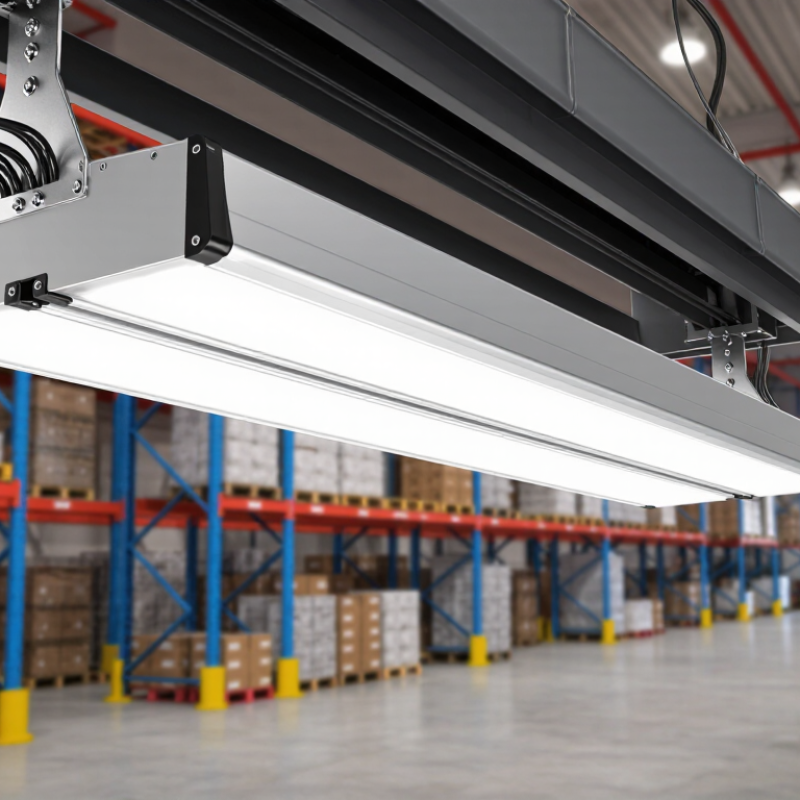
An LED tri-proof light is a sealed linear fixture designed for dusty, wet, or demanding indoor environments. “Tri-proof” usually refers to protection against dust, water, and corrosion, although specifications differ by manufacturer. Its housing often uses polycarbonate, aluminum, or treated steel, while sealed end caps reduce moisture entry. The light source is an LED board, powered by a driver that converts incoming electricity into stable current. Unlike fluorescent tubes, it starts instantly and contains no fragile glass tube.
Key features should be checked through measurable standards. IEC 60529 defines IP ratings for enclosure protection; IP65 resists dust and low-pressure water jets, while IP66 adds stronger water-jet protection. Impact resistance may be listed under IEC 62262, such as IK08. The U.S. Department of Energy’s Solid-State Lighting report notes that laboratory LED packages can exceed 200 lumens per watt, but complete fixtures deliver less because of optics, drivers, and thermal losses. That gap matters. A bright fixture can still waste energy if heat cannot escape.
Tips:
Select the IP rating for the actual cleaning method, not the product label alone. Check operating temperature, surge protection, color temperature, and warranty terms. The IEA’s Energy Efficiency 2024 report identifies efficient lighting as a practical electricity-saving measure, but installation quality remains important. Poor wiring or blocked ventilation can shorten service life. No fixture is perfect. Condensation, corrosion, and glare still need site-specific review.
How the LED Tri-Proof Light Produces and Distributes Illumination
An LED tri-proof light is a sealed linear fixture designed for demanding spaces. “Tri-proof” commonly refers to resistance against water, dust, and corrosion. It does not mean invincible. Inside, light-emitting diodes convert electrical energy into visible light through semiconductor junctions. A driver regulates current and changes incoming power into a stable supply. This control matters because unstable current can reduce output and shorten component life. In a typical installation, the LEDs sit on a metal board. The board spreads heat toward the housing. Heat management is often overlooked.
Illumination begins at each diode, where electrons release energy as photons. A phosphor layer usually shifts part of the emitted blue light into broader colors. Together, these wavelengths create the white light seen by the eye. A diffuser then softens bright points and distributes light across the working area. Its texture and shape affect glare, shadows, and perceived uniformity. Reflective surfaces inside the housing can redirect stray light downward. The result is a wider beam than a bare LED board can provide. Not every fixture distributes light evenly, however.
Mounting height, spacing, lens design, and wall reflectance all change the final pattern. For example, a low ceiling may produce bright bands beneath the fixture. Wider spacing can leave darker gaps between rows. Measuring illuminance at floor or work-surface level gives a more reliable assessment than judging brightness by eye. In practice, I would inspect beam overlap and driver temperature after installation. A cool, evenly lit surface is a good sign, but it is not proof of perfect performance. Dust, aging, and incorrect wiring can still alter output over time.
The Main Components Inside an LED Tri-Proof Fixture
An LED tri-proof light is built for damp, dusty, and demanding spaces. Its sealed housing protects the internal electrical parts. The body is usually made from polycarbonate or coated metal. A clear diffuser spreads light across floors, aisles, and work areas. It also reduces harsh glare from exposed LED points.
The LED board creates light when electric current passes through its diodes. Small chips sit on the board in an arranged circuit. The driver controls incoming power and supplies a steady current. Without it, the LEDs may flicker, overheat, or fail early. The driver needs airflow and electrical protection. Thermal pads or an internal metal plate move heat away from the LED board. Heat matters more than many installers expect. Even a bright fixture can age quickly in a hot ceiling.
Sealing components complete the tri-proof structure. Gaskets sit around the diffuser, end caps, and cable entry points. Waterproof connectors help prevent moisture from reaching live terminals. Mounting clips hold the fixture firmly against a wall or ceiling. In practical inspections, loose clips and compressed gaskets often deserve attention. They are easy to overlook. The design is not flawless; poor installation can defeat good engineering. A pinched seal, damaged cable, or incorrect driver connection may reduce safety and service life. Checking these details before energizing the fixture is a small step, but it prevents costly mistakes.
Protection Against Water, Dust, Impact, and Corrosion
What Is an LED Tri-Proof Light and How Does It Work?
An LED tri-proof light is built for places where ordinary lighting may fail. Its three main protections are against water, dust, and impact. Many models also resist corrosion in humid or chemically active environments. They are commonly used in workshops, parking areas, warehouses, food-processing spaces, and covered outdoor locations.
The housing uses a sealed body, a tight diffuser, and protected cable entry points. These parts limit dust and water from reaching the LEDs and internal driver. An IP rating, such as IP65 or IP66, indicates its tested resistance to solids and water. The exact rating matters. “Waterproof” is not a complete technical description.
Impact protection may also be shown through an IK rating. A strong polycarbonate diffuser can handle knocks from tools, carts, or routine maintenance.
Corrosion protection depends on the housing material, surface coating, and installation environment. Aluminum, treated steel, and stainless-steel components can improve long-term reliability.
Still, no fixture is maintenance-free. Salt, cleaning chemicals, and damaged seals can weaken protection over time. Check cable glands, end caps, and mounting points during inspections.
Heat also deserves attention, because poor ventilation can shorten LED and driver life. The design may be rugged, but installation quality remains part of the protection.
Common Applications and Installation Considerations
An LED tri-proof light is a sealed luminaire designed for dust, moisture, and impact-prone areas. Its housing usually combines a gasketed lens, corrosion-resistant body, and protected electrical connections. “Tri-proof” describes durability, not one universal performance level. Check the actual IP and IK ratings against IEC 60529 and IEC 62262.
Common applications include warehouses, parking garages, workshops, food-processing areas, tunnels, and covered walkways. These spaces need even illumination, quick starting, and reliable operation during temperature changes. The International Energy Agency reported that LEDs represented about 50% of global lighting sales in 2022, although they made up only around 15% of installed lighting stock. This shows strong adoption, but replacement quality still varies.
Installation needs more than matching wattage. Measure mounting height, beam distribution, surface reflectance, and required illuminance before choosing a fixture. A 150-centimeter replacement may leave dark bands if existing mounting points differ. Allow space around the housing for heat dissipation. Use suitable cable glands, sealed junctions, and correctly rated circuits in wet locations. In cold rooms, confirm the driver’s operating range and check for condensation risks. Emergency lighting requires separate verification.
A neat housing is not enough. Poor cable entry can defeat the enclosure rating. The U.S. Department of Energy’s solid-state lighting research reports show continuing gains in efficacy and reliability, but real savings depend on controls, operating hours, and maintenance. I would also review glare. Bright is not always comfortable. A short on-site test often reveals problems that a catalogue cannot.
What Is an LED Tri-Proof Light and How Does It Work? - Common Applications and Installation Considerations
| Data Dimension | Typical Specification or Feature | How It Works or Why It Matters | Application and Installation Notes |
|---|---|---|---|
| Definition | Sealed LED linear luminaire designed to resist dust, water, and impact | The housing, diffuser, end caps, and cable entry points are combined into a protected enclosure for demanding indoor or outdoor environments. | Confirm the required ingress and impact ratings before selecting the fixture. |
| “Tri-Proof” Protection | Commonly refers to protection against dust, moisture, and corrosion | The term describes a product category rather than one universal certification. Actual performance depends on the tested IP, IK, corrosion, and electrical ratings. | Always check the product test documentation instead of relying only on the term “tri-proof.” |
| Ingress Protection | IP65, IP66, or IP67 are common choices | IP65 indicates protection against dust and water jets; IP66 provides protection against powerful water jets; IP67 also covers temporary immersion under specified test conditions. | Use the rating appropriate to the cleaning method, weather exposure, and mounting location. |
| Impact Protection | IK08 to IK10 is frequently specified for industrial or public areas | The IK rating indicates resistance to mechanical impact. A higher number generally means greater tested impact resistance. | Consider higher impact protection in warehouses, workshops, sports facilities, and areas exposed to equipment movement. |
| Light Source | Integrated LED modules or LED boards | LEDs convert electrical energy into light through electroluminescence. They turn on immediately and do not require fluorescent tubes or starters. | Integrated designs are compact, but the complete fixture may need replacement if the LED module or driver reaches the end of its service life. |
| Typical Power Range | Approximately 20–80 W for many linear models | Power depends on fixture length, LED density, optical design, and required light output. | Check the actual input wattage when sizing circuits, emergency systems, and energy budgets. |
| Common Lengths | Approximately 600 mm, 1,200 mm, and 1,500 mm | Standardized lengths can simplify replacement, spacing, and connection planning. | Measure the mounting surface and confirm cable-entry locations before installation. |
| Typical Efficacy | Approximately 100–160 lm/W, depending on design | Luminous efficacy expresses how much visible light is produced per watt of electrical power. | Compare efficacy together with delivered lumens, glare control, color quality, and operating temperature. |
| Color Temperature | Usually 3,000 K, 4,000 K, or 5,000–6,500 K | Lower color temperatures appear warmer, while higher color temperatures appear cooler and more bluish. | Use neutral white around 4,000 K for many work areas; select according to visual comfort and site requirements. |
| Color Rendering | CRI 80 or higher is common; higher CRI is available for color-critical tasks | Color Rendering Index indicates how accurately a light source reveals colors compared with a reference source. | Choose higher color rendering where product inspection, food presentation, healthcare, or detailed visual work is involved. |
| Operating Voltage | Commonly 100–277 V AC or 220–240 V AC, depending on the electrical system | An internal LED driver converts incoming AC power into the controlled current required by the LED circuit. | Verify the fixture’s rated voltage, frequency, driver type, and local electrical requirements before wiring. |
| Driver Function | Regulates current and may provide power-factor correction and protection | The driver helps maintain stable LED operation and can protect against conditions such as overcurrent or input-voltage variation. | For dimming or controls, confirm compatibility with the selected control protocol and driver. |
| Thermal Management | Heat is transferred through the LED board, housing, and surrounding air | Lower LED junction temperatures generally support better light stability and longer component life. | Do not cover the luminaire or install it where excessive heat from other equipment can accumulate. |
| Diffuser and Housing | Polycarbonate or similar impact-resistant diffuser with a sealed body | The diffuser distributes light while the housing protects the LEDs and driver from environmental exposure. | Use a diffuser suitable for ultraviolet exposure, cleaning chemicals, and the required impact level. |
| Common Applications | Parking areas, warehouses, workshops, garages, food-processing spaces, tunnels, and covered outdoor areas | The sealed construction suits locations where dust, humidity, water spray, vibration, or frequent cleaning may occur. | Match the fixture to hygiene rules, chemical exposure, ambient temperature, and required illuminance. |
| Mounting Methods | Surface mounting, suspension mounting, or continuous-row mounting | Mounting clips or brackets support the enclosure, while suspension kits position the fixture at the required height. | Use manufacturer-approved hardware and ensure the mounting surface can support the luminaire safely. |
| Electrical Installation | Connect line, neutral, and protective earth where required | Correct wiring supplies the driver safely and maintains the protective function of the installation. | Disconnect power before work and have installation completed or inspected by a qualified electrician. |
| Cable Glands and Seals | Use correctly sized glands, gaskets, plugs, and connectors | Water and dust resistance can be reduced if cable entries are loose, damaged, or improperly sealed. | Do not leave unused cable openings unsealed; maintain the enclosure rating after wiring. |
| Ambient Temperature | Often approximately −20°C to +45°C, but the exact range varies by model | LED output, driver reliability, and service life can be affected by temperatures outside the rated range. | Check the specified ambient range for cold rooms, hot production areas, and outdoor installations. |
| Maintenance | Low maintenance compared with fluorescent alternatives | LEDs have no tubes or starters to replace, and sealed housings reduce the entry of dust and moisture. | Clean the diffuser when necessary and inspect seals, cable glands, brackets, and electrical connections periodically. |
| Energy and Service Life | Lower energy use and long rated life when correctly specified and operated | LED efficiency, controlled current, and reduced relamping requirements can lower operating and maintenance costs. | Review rated life, lumen maintenance, switching frequency, driver quality, and operating temperature together. |
