Why Choose Commercial Complex Fountains for Your Project?
Commercial Complex Fountains can give a development more than visual drama. They can create a recognizable arrival point, guide pedestrians, and soften traffic noise beside retail entrances. A 12-meter linear basin can frame a hotel lobby, while a shallow runnel can lead visitors toward restaurants or transit connections. These details influence how people pause, meet, and remember a place.
The opportunity must be designed responsibly. The U.S. Environmental Protection Agency reports that commercial and institutional facilities account for about 17% of publicly supplied water in the United States (EPA WaterSense, Commercial and Institutional Facilities). This makes efficient circulation, leak detection, filtration, and automatic water-level controls essential. Water-efficient fixtures can reduce consumption by at least 20%, according to the EPA WaterSense program, although that figure does not directly measure fountain systems. The distinction matters.
Energy performance also deserves attention. The 2023 Global Status Report for Buildings and Construction, published by UNEP and the Global Alliance for Buildings and Construction, found that buildings and construction represented 37% of global energy and process-related carbon emissions in 2022. Variable-speed pumps, LED lighting, timed operation, and renewable-energy integration can reduce a fountain’s operating burden. However, sustainability claims should be measured, not assumed.
The International WELL Building Institute emphasizes comfort, sound, and environmental quality in human-centered spaces. Properly tuned water noise may support a calmer atmosphere, but excessive splash can frustrate visitors and nearby tenants. A fountain can also fail. Poor maintenance quickly reveals algae, cloudy water, and damaged finishes. Careful planning, accessible servicing, and transparent performance data make Commercial Complex Fountains a credible long-term investment, rather than an expensive ornament.
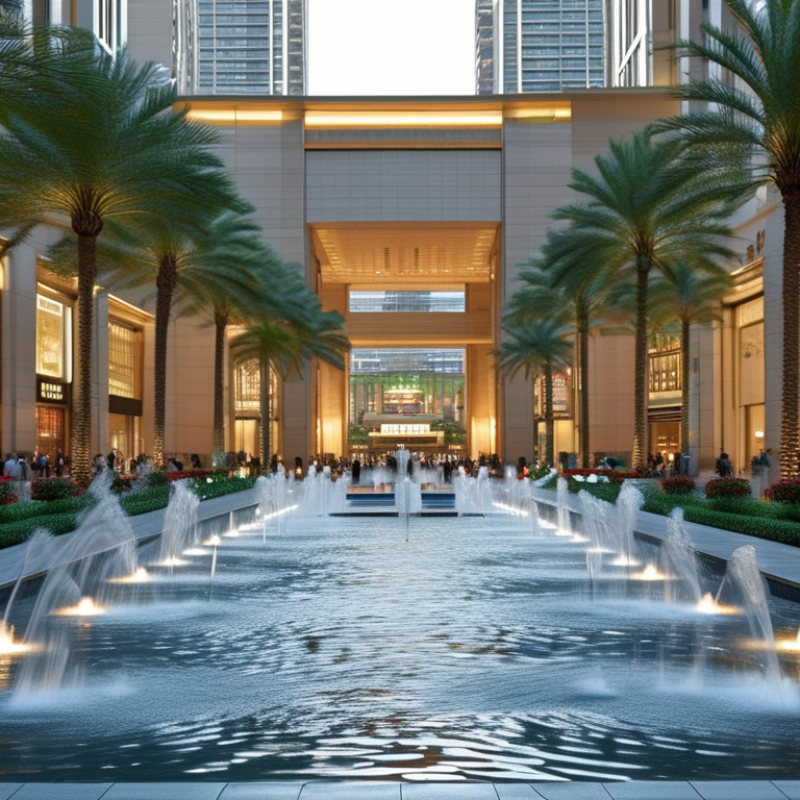
Commercial Fountain Types and Their Roles in Mixed-Use Developments
Why Choose Commercial Complex Fountains for Your Project?
Commercial Fountain Types and Their Roles in Mixed-Use Developments
Mixed-use developments need more than attractive water features. They need spaces that guide movement, support identity, and encourage people to stay. A plaza fountain can create a clear arrival point beside retail entrances. Its steady sound may also soften traffic noise near restaurants and outdoor seating.
Interactive fountains work well in family areas and open public squares. Flush nozzles keep the paving level when the system is off. This supports events, pedestrian flow, and easier maintenance access. Architectural fountains suit hotel lobbies, office courtyards, and premium residential entrances. Their height, lighting, and water rhythm can make a narrow space feel more purposeful. Still, excessive spray can wet nearby paving. That becomes a slip concern.
Reflecting pools provide calm visual focus, especially beside offices or residential towers. They require careful filtration, drainage, and cleaning plans. A neglected pool quickly weakens the project’s image. Rainwater-integrated features can support a wider water strategy, but they need reliable treatment and overflow control. Local climate matters more than many early concepts suggest.
Good fountain planning begins with circulation, not decoration. Designers should study shade, wind, seating, service routes, and nighttime visibility. Pumps, access panels, and treatment equipment need practical locations. These details are rarely glamorous. They determine long-term reliability. A fountain that looks impressive in a rendering may become expensive when maintenance access is ignored. The best choice balances atmosphere, safety, operating cost, and the daily behavior of real users.
Water Efficiency: EPA WaterSense Products Use at Least 20% Less Water
Why Choose Commercial Complex Fountains for Your Project?
Water Efficiency: EPA WaterSense Products Use at Least 20% Less Water
A commercial fountain can shape a visitor’s first impression. It can also influence monthly operating costs. In my experience, water performance depends on more than basin size. Pumps, nozzles, controls, and filtration systems must work together. EPA WaterSense products use at least 20% less water than comparable standard products. This reduction can matter in busy shopping centers and office complexes.
The savings begin with controlled flow. Efficient nozzles create clear patterns without excessive spray or overspill. Sensors can adjust operation during quiet hours. Proper filtration also reduces the need for frequent draining. I have seen poorly balanced fountains waste water through wind drift and constant refilling. Small design errors become expensive over time.
Maintenance remains essential. A certified product does not remove the need for inspections. Staff should check leaks, evaporation, pump settings, and water quality. Local climate also changes the results. Dry, windy sites may need additional controls. The 20% figure is useful, but it is not a promise for every project. Designers should confirm product data and estimate real site conditions. Sometimes, a smaller water display performs better than a dramatic feature. That choice may disappoint visually, yet it can support responsible operation.
Pump Energy: 20% Lower Speed Can Cut Power by About 49% (DOE)
Why Choose Commercial Complex Fountains for Your Project?
Pump Energy: 20% Lower Speed Can Cut Power by About 49% (DOE)
Commercial complex fountains must balance visual impact, operating cost, and reliable daily performance. Pump speed deserves careful attention because small adjustments can produce significant energy savings. Under the pump affinity laws, reducing speed by 20% may lower power demand by approximately 49%. The calculation comes from the cubic relationship between speed and power.
The savings are real. However, they are not automatic. A fountain system must maintain suitable flow, nozzle pressure, water levels, and circulation. If speed drops too far, streams may weaken, splash patterns may change, or water may collect unevenly around the basin. Experienced project teams test these conditions during commissioning instead of trusting calculations alone.
Variable-frequency drives can help operators match pump output with visitor traffic, weather, and programmed display schedules. A quieter evening setting may use less energy than a daytime performance. Installers should record baseline power, running speed, pressure, and flow before making changes. Measure it. That evidence supports better decisions and exposes hidden losses, such as clogged filters or poorly adjusted valves. I have seen energy plans focus heavily on pump speed while ignoring maintenance. That is an imperfect approach. A slower pump cannot compensate for a system designed with unnecessary resistance. Regular inspection, practical hydraulic design, and honest performance data make the savings more dependable.
Why Choose Commercial Complex Fountains for Your Project? - Pump Energy: 20% Lower Speed Can Cut Power by About 49% (DOE)
| Performance Dimension | Engineering Relationship | 100% Speed | 90% Speed | 80% Speed | Change at 80% Speed |
| Pump Affinity Law Comparison |
| Pump rotational speed | Reference operating speed | 100% | 90% | 80% | 20% lower |
| Approximate water flow | Flow ∝ speed | 100% | 90% | 80% | 20% lower |
| Approximate pump head | Head ∝ speed² | 100% | 81% | 64% | 36% lower |
| Approximate pump power | Power ∝ speed³ | 100% | 72.9% | 51.2% | 48.8% lower |
| Power reduction expressed as a rounded figure | 1 − (0.80³) | — | — | — | About 49% |
| Illustrative Commercial Fountain Energy Calculation |
| Reference pump input power | Project design assumption | 100 kW | — | — | Baseline |
| Estimated pump input power at 80% speed | 100 kW × 0.80³ | 100 kW | — | 51.2 kW | 48.8 kW less |
| Operating schedule | Planning assumption for comparison | 8 hours/day | 8 hours/day | 8 hours/day | 300 days/year |
| Annual operating hours | 8 hours/day × 300 days/year | 2,400 hours | 2,400 hours | 2,400 hours | Same schedule |
| Estimated annual electricity use | Input power × operating hours | 240,000 kWh | — | 122,880 kWh | 117,120 kWh less |
| Electricity tariff used for illustration | Example calculation only | $0.15/kWh | — | $0.15/kWh | Tariffs vary by location |
| Estimated annual electricity cost | Annual electricity use × tariff | $36,000 | — | $18,432 | $17,568 lower |
| Project Planning Implications |
| Variable-speed control | Adjusts water display intensity to operating conditions | Potentially reduces pump speed during off-peak periods | Requires compatible controls and hydraulic design |
| Water display performance | Flow and head decrease as speed decreases | Lower-speed operation may produce smaller jets or reduced circulation | Confirm minimum acceptable visual effect |
| Energy-saving suitability | Most effective when full output is not continuously required | Useful for schedules, quiet hours, and adaptive fountain scenes | Evaluate the complete operating profile |
Calculation basis: The pump affinity laws state that, for a centrifugal pump with the same impeller diameter and comparable operating conditions, flow is approximately proportional to speed, head is proportional to speed squared, and power is proportional to speed cubed. The 48.8% power reduction is calculated as 1 − (0.80³). Actual results depend on pump efficiency, system resistance, controls, water level, nozzle requirements, and operating conditions.
Public Safety: ADA Routes Require at Least 36 Inches of Clear Width
Why Choose Commercial Complex Fountains for Your Project?
Public safety should shape fountain planning from the first sketch. In the United States, the 2010 ADA Standards, Section 403.5.1, require accessible routes to provide at least 36 inches of clear width. That space must remain usable, not merely appear open on a drawing. Benches, planters, control panels, and wet-floor barriers can quickly reduce the route. A wheelchair user needs steady clearance beside the fountain, especially near busy entrances and food courts. The Centers for Disease Control and Prevention reports that about one in four U.S. adults has a disability. This makes accessible circulation a daily planning issue, not a rare exception.
Commercial complex fountains can support safer movement when their basins, edges, and viewing areas are carefully positioned. The U.S. Access Board also identifies passing spaces and turning areas as important where routes become constrained. A 36-inch path may be compliant in one section, yet uncomfortable during peak traffic. That is where designs often need more generosity. I have seen attractive fountain layouts lose practical value because maintenance carts or seasonal displays blocked the route. Water splash, glare, and slippery paving deserve equal attention.
Tips: Keep the clearest route beside, rather than directly through, the fountain’s busiest viewing zone. Measure finished surfaces after installation. Recheck the path with furniture, queues, and maintenance equipment in place. Consider contrast edges and firm, slip-resistant paving. Document these checks in the project file, since small site changes can quietly reduce accessibility.
Why Choose Commercial Complex Fountains for Your Project?
Public safety is a key design consideration. Under the 2010 ADA Standards for Accessible Design, accessible routes require at least 36 inches of clear width, while passing and turning spaces require 60 inches.
Reference benchmarks: 36-inch minimum clear route width, 60-inch minimum passing space width, and 60-inch turning-space diameter. Values are based on the 2010 ADA Standards for Accessible Design.
Lifecycle Value: Use ASTM E917 to Compare Fountain Ownership Costs
Why Choose Commercial Complex Fountains for Your Project?
Lifecycle Value: Use ASTM E917 to Compare Fountain Ownership Costs
A commercial fountain should be evaluated as a long-term building system, not only as a visual feature. ASTM E917 provides a structured method for comparing initial, operating, maintenance, replacement, and residual costs. That scope matters. A lower purchase price may hide higher electricity use, water treatment, or service labor.
The U.S. Department of Energy’s 2018 Commercial Buildings Energy Consumption Survey identified about 5.9 million commercial buildings across nearly 97 billion square feet. This scale highlights why small efficiency differences can become significant portfolio expenses. For a fountain, record pump power, operating hours, basin volume, filtration demand, water replenishment, and seasonal shutdowns. ASHRAE guidance also shows that evaporation and water loss vary with air movement, temperature, and humidity. A sheltered indoor basin may perform very differently from an exposed plaza installation.
Build the ASTM E917 model with local utility rates and realistic labor costs. Include pump replacement, coating repairs, nozzle cleaning, lighting upgrades, and winter drainage. Test several discount rates and service intervals. A spreadsheet can still mislead. Actual maintenance records are better than optimistic assumptions. For example, a 4-kilowatt pump running 12 hours daily uses roughly 17,500 kilowatt-hours annually, before lighting and controls. The U.S. Environmental Protection Agency’s WaterSense program emphasizes efficient water management, but fountain savings depend heavily on design and operating discipline. Measure both beauty and burden.
